
Se sei l’emittente di una community radio austriaca, riceverai un account dal tuo coordinatore programmi.
Se sei un/a podcaster indipendente, una stazione radio o vuoi partecipare in qualità di organizzazione, inviaci un’e-mail all’indirizzo office@cba.media e ti faremo sapere quali sono le possibilità a tua disposizione.
Puoi trasmetterci facilmente tutti i tuoi file con l’ausilio di un feed RSS del tuo podcast. Forniamo una funzione di importazione che fa tutto automaticamente per te. È importante che tu disponga dei diritti di pubblicazione online (“messa a disposizione”) su questo materiale.
Gli host commerciali di podcast generalmente conservano i tuoi dati all’estero e spesso lo fanno in Paesi con poche norme di protezione dei dati. Non è inusuale che i tuoi dati vengano venduti per fini pubblicitari e dietro l’applicazione di condizioni di contratto inique. Noi conserviamo tutti i dati su server austriaci e possiamo pertanto garantire una protezione dei dati a livello europeo. Siamo un’organizzazione senza scopo di lucro e non vendiamo dati, siano essi relativi al tuo contenuto o ai tuoi dati personali. Le nostre condizioni di contratto offrono la protezione e la sovranità dei tuoi dati, assicurandoti così un contesto equo per fare podcasting.
Le altre funzioni disponibili sono:
Sì. Offriamo funzioni su misura e prezzi personalizzati alle istituzioni (come università, musei, associazioni, ecc.) che gestiscono una gamma di dati potenzialmente ampia. Grazie ai backup giornalieri interni ed esterni, siamo in grado di garantire la disponbilità delle tue produzioni sul lungo termine. Contattaci direttamente all’indirizzo office@cba.media.
Sì, esistono i cosiddetti Channel Manager Account con i quali puoi gestire gli utenti del tuo canale in modo indipendente ed assegnare i diritti di accesso a podcast e videocast. Forniamo inoltre tool per la modifica di massa, nonché funzioni di esportazione. Contattaci direttamente all’indirizzo office@cba.media.
Da Wikipedia: con podcast si intende una serie di file multimediali (audio o video) su Internet, perlopiù in abbonamento. La parola ombrello inglese “podcast” è costituita da “pod” (“capsula”, “bacello”), che deriva dal nome dell’iPod, l’audio player portatile su cui è stato ampiamente utilizzato questo strumento inizialmente, e il termine ‘broadcast’ (messa in onda). Intorno al 2016, i podcast sono stati ascoltati soprattutto dagli smartphone. Di fronte alla crescente popolarità degli smartphone e al successo di alcuni podcast, essi sono diventati sempre più popolari anno dopo anno. Un singolo podcast è costituito da una serie (episodi) di articoli mediatici (ad es. interviste, report, registrazioni di programmi radiofonici, programmi musicali, ecc.) ottenibili automaticamente tramite un feed RSS. (Testo con licenza ottenuta su CC BY-SA 3.0).
Ogni tuo podcast possiede un cosiddetto feed RSS (“Really Simple Syndication”), collocato sul sito https://cba.media/podcast/name-of-the-podcast/feed. Si tratta di un documento leggibile automaticamente, che i tuoi ascoltatori e le tue ascoltatrici possono utilizzare per iscriversi al tuo podcast con un podcatcher. Un podcatcher è un programma o un’applicazione per l’iscrizione ai podcast. Chi ti ascolta sarà così informato automaticamente dell’uscita dei nuovi episodi senza che debbano visitare il sito stesso.
Tutto quello che devi sapere è solo l’URL del tuo feed per poterlo passare: lo puoi scoprire sulla schermata iniziale dopo aver effettuato il login ("View feed URLs").
Puoi utilizzare il feed per distribuire il tuo podcast su altre piattaforme o directory di podcast. Tutto ciò che devi fare è sapere il suo indirizzo e copiarlo nel posto giusto. A tal fine, una volta effettuato il login, sulla schermata iniziale riceverai un link che potrai utilizzare per visualizzare gli URL dei feed dei tuoi podcast.
Maggiori informazioni sono disponibili qui
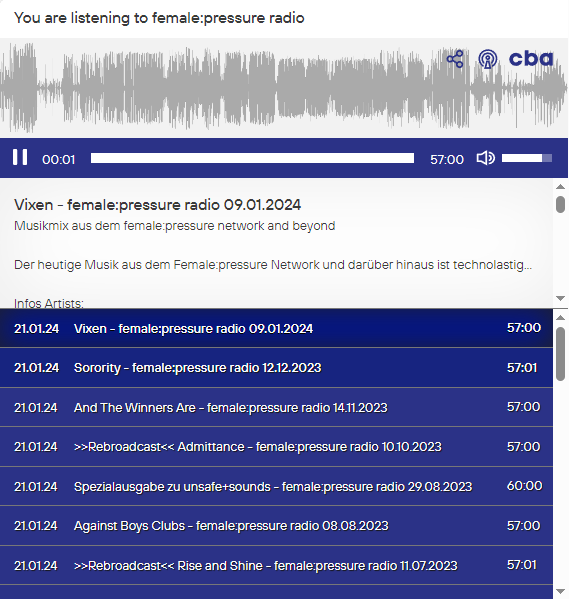
Con il podcast player puoi integrare automaticamente tutti i tuoi contributi su un sito web esterno per un ascolto veloce. Nella schermata iniziale che ti appare dopo aver effettuato il login, troverai un link attraverso il quale potrai facilmente generare un frammento di codice con il quale potrai inserire il player.
Maggiori informazioni sono disponibili qui
Puoi integrare singoli post a pagine esterne utilizzando il player integrato. Per farlo, vai alla pagina di un post (ad es. https://cba.media/1234) e clicca su </> all’interno dell’onda sonora per generare un frammento di codice che puoi semplicemente copiare in un’altra pagina.
You can share the RSS feed of your podcast (e.g. https://cba.media/podcast/stimmlagen/feed on Apple Podcasts and Spotify. To do this, you must enter the fields “Contact person”, “Contact email” and “Apple Podcasts.) when editing the podcast Category”.
You also need an image for your podcast. It must be square for both platforms, and between 1,600 and 3,000 pixels wide or high for Apple Podcasts. Apple Podcasts itself recommends an image size of 3,000 x 3,000 pixels. Allowed file formats are: PNG or JPG.
Sì. Per farlo, basta copiare l’URL di un post, podcast, canale o stazione e incollarlo sulla tua pubblicazione. A tal fine, dovresti caricare un’immagine sul tuo post (o almeno sul tuo podcast) che abbia una larghezza di almeno 1200 pixel e un’altezza di almeno 628 pixel ed inserire una descrizione.
Purtroppo non è possibile integrare un audio player sui social media. Tuttavia, in futuro intendiamo offrire un tool di conversione da audio a video che ti consentirà di trasformare automaticamente in video i tuoi file audio e di inserirli poi direttamente sui social media.
Vedi “Come posso distribuire il mio podcast?”
Per casi del genere, forniamo una REST API che può essere personalizzata alle esigenze di ognuno. Contattaci direttamente all’indirizzo office@cba.media.
Eseguiamo il backup internamente ed esternamente due volte al giorno ad orari diversi. Nel caso in cui l’hardware si danneggiasse, possiamo così ripristinare i dati in qualsiasi momento. Disponiamo inoltre di numerosi sistemi di sicurezza che garantiscono un’accessibilità continua. Stiamo sviluppando in modello tariffario per assicurare una disponibilità che sia davvero duratura, per anni o decenni.
I sottotitoli migliorano l’accessibilità per le persone non udenti, con deficit dell’udito e per quelle che parlano un'altra lingua, rendendo i contenuti più accessibili a chiunque. Essi aiutano inoltre i motori di ricerca a trovare più facilmente i contenuti, aumentandone la diffusione.
La trasposizione testuale del parlato è altresì la base di molti altri utilizzi futuri che su di essa si basano. Stiamo così preparando il terreno. Essi includono il perfezionamento della funzione di ricerca, il suggerimento di contenuti, la semplificazione o l’automatizzazione parziale della scelta delle parole chiave, la traduzione automatica e molto altro ancora.
La generazione automatica semplifica il processo e fa risparmiare tempo. La trascrizione o la sottotitolazione eseguite manualmente sono dispendiose in termini di tempo e richiedono molte risorse, in quanto si deve ricorrere a persone che convertano in testo il contenuto parlato per ogni lingua e per ogni epidosio.
I sottotitoli vengono generati con l’ausilio di Whisper AI, un algoritmo di conversione da parlato a testo sviluppato da Google. Esso è in grado di convertire il parlato in testo in oltre 50 lingue ed è open-source, ossia è basato su codice sorgente aperto ed è utilizzabile liberamente. Essendo l’addestramento di un algoritmo molto costoso, noi (come molti altri) dobbiamo affidarci a tecnologie esistenti come Whisper AI.
L’algoritmo converte i cosiddetti fonemi (suoni linguistici) in lettere, sillabe ed infine in parole. Sono diversi i metodi che vengono utilizzati per migliorare il riconoscimento o incrementare la comprensibilità per il lettore. Per esempio, esso filtra le alterazioni grammaticali del flusso discorsivo, come “Ehm” e “Ah”, oppure trasforma alcune espressioni dialettali in altre generalmente più comprensibili.
Inoltre, si utilizzano i cosiddetti “glossari” con il fine di riconoscere e riprodurre determinati termini utilizzati esclusivamente in una specifica area linguistica o dialettale. Siccome questi glossari sono addestrati maggiormente con termini tedeschi riconducibili alla variante parlata in Germania, essi sono meno in grado di riconoscere termini specificatamente austriaci quali “Nationalrat”, “Bezirkshauptmannschaft” o nomi propri come “Freistadt”. In questi casi potrebbe pertanto accadere che, se non presenti nel glossario, i termini vengano trascritti in modo errato anche se pronunciati chiaramente. Per esempio, la città “Freistadt” può talvolta divenire “Freistaat”.
Il perfezionamento dell’algoritmo è continuo e si può presumere che anche la qualità del tedesco nella sua variante austriaca continuerà a migliorare.
La sottotitolazione richiede solitamente da un sesto ad un terzo della durata totale dell’audio. La durata dipende dalla quantità di parlato o di musica, dalle lingue parlate e dal modo in cui parlano gli interlocutori. In media, la trascrizione automatica di un file di un’ora avviene in circa 10-20 minuti.
La creazione avviene in background e richiede molta potenza da parte del computer, il che risulta essere dispendioso in termini di tempo e di costi. Dapprima trascriviamo l’intero database, per migliorare innanzitutto la funzione di ricerca. I nuovi file sono trascritti solo se sono stati pubblicati, con il fine di risparmiare risorse e tempo. Non appena il processo di trascrizione sarà concluso (e richiederà più di un anno), rifletteremo sulla possibilità di darti più controllo sul processo di trascrizione.
Molti dei post pubblicati su cba contengono descrizioni troppo brevi o troppe poche parole chiave. Essi possono tuttavia essere trovati solo se includono abbastanza informazioni di tipo testuale. A tal fine, arricchiamo il nostro indice di ricerca con le trascrizioni e, in una fase successiva, possiamo anche filtrare le parole chiave significative, proponendole quando si scelgono le parole chiave da inserire. Quest’operazione non consente solo di ottenere risultati di ricerca più precisi, ma anche un miglior equilibrio: così facendo, sarà possibile diffondere anche contenuti archiviati che fino a quel momento contenevano troppe poche informazioni testuali o nessuna.
La correttezza della trascrizione dipende da una serie di fattori
Whisper AI utilizza un cosiddetto modello linguistico che converte i suoni in testo. Per capire un modo specifico di parlare, come un dialetto, tale tecnologia ha bisogno di molte informazioni su come le persone parlano in quel dialetto. I dati per l’addestramento sono disponibili spesso in misura variabile a seconda della lingua e dell’area dialettale. Di conseguenza, questi algoritmi tendono ad essere addestrati ad esempio con le varianti della lingua tedesca, il che significa che il tedesco ufficiale standard viene riconosciuto molto meglio di alcuni dialetti.
Oltre che dal modo di parlare, la qualità della trascrizione dipende soprattutto dalla qualità del suono. Il suono “tenue” o ovattato, il clipping/la distorsione, il riverbero e persino il bit-rate (per esempio il tasso di compressione di un MP3) possono compromettere seriamente la qualità, provocando pertanto errori nei sottotitoli.
Tuttavia, puoi correggere manualmente questi errori utilizzando l’editor di sottotitoli.
Sì, i sottotitoli generati automaticamente possono essere modificati nell’editor di sottotitoli per assicurarsi che siano corretti. Qui puoi scoprire come si utilizza.
Sì, con l’editor di sottotitoli puoi esportare e scaricare sia i sottotitoli sotto forma di file WebVTT che l’intera trascrizione sotto forma di testo.
Puoi utilizzare cba per pubblicare i tuoi file da qualsiasi luogo e in qualsiasi momento, mantenendo il controllo completo sui tuoi contenuti.
I tuoi contributi saranno pubblicati unicamente ai fini del libero accesso all’informazione e non verrai usato commercialmente da noi in nessun modo.
Per mettere a disposizione il materiale pubblicato, devi avere il consenso di tutti i titolari di copyright.
Ai sensi della legge sull’e-commerce, la persona responsabile del contenuto ha l’obbligo di divulgare le note legali. Pertanto, sul tuo profilo utenti è necessario che specifichi il tuo nome e luogo di residenza. Verrano pubblicati solo il nome e il codice postale, non l’intero indirizzo.
In caso di violazione della legge, solleverai l’operatore di cba da qualsiasi responsabilità.
Per poter utilizzare cba, sei tenuto ad accettare le presenti condizioni di contratto (“Accordo di utilizzo”).
Noi, in quanto host provider, dobbiamo tutelarci legalmente dai nostri uploader per evitare che l’intero database sia a rischio laddove ci siano persone che violino la legge.
L’accordo di utilizzo è costituito essenzialmente da quattro parti:
Il contratto sul trattamento dei dati stabilisce quali dati ci concedi di trattare per consentirci di rendere disponibili i tuoi contributi (e i dati ivi contenuti). Tieni presente che molto di quello che viene detto nel tuo podcast sono dati personali: già la voce, ad esempio, lo è. Il contratto afferma altresì chiaramente quali sono i diritti e gli obblighi che entrano in gioco per la gestione dei tuoi dati. Ricorriamo inoltre a due partner commerciali: l’host culturale e artistico senza scopo di lucro servus.at, il quale controlla i nostri server e ci fornisce la connessione interna, e Proserver1, un’azienda individuale che esegue i nostri backup giornalieri dei dati. Per far sì che i tuoi podcast siano accessibili su cba e che vi sia un backup esterno, anche queste due organizzazioni sono parte integrante del contratto. Inoltre, non cederemo, né venderemo a nessuno i tuoi dati. Al contrario, vogliamo che tu possa rendere disponibili i tuoi contributi liberamente senza l’imposizione di condizioni d’uso che ti costringano a vendere i tuoi dati personali, come nel caso di tutte le piattaforma commerciali (come Facebook o YouTube).
In qualità di uploader, sei il proprietario dei media dei tuoi contributi e ne sei pertanto responsabile. A questo si aggiunge l’obbligo di fornire le note legali in conformità a quanto prescritto dalla legge sull’e-commerce. Questa è la ragione per cui sotto ogni post sono riportati il tuo nome e il tuo indirizzo e-mail. Per lo stesso motivo, questi dati vengono trasferiti tramite le nostre interfacce in modo tale che queste informazioni obbligatorie possano figurare anche sui siti esterni. Proteggiamo attivamente tutti gli altri dati personali da divulgazione e abuso. Conserviamo il tuo indirizzo perché, in caso di ingiunzione per motivi giudiziari, siamo tenuti a comunicarlo.
In linea generale, devi ottenere i diritti per rendere disponibile online (“messa a disposizione”) qualsiasi materiale da te pubblicato. Se hai ottenuto le licenze d’uso da parte dell’autore/trice, del redattore/trice o della società di gestione collettiva, hai la strada spianata. In caso contrario, non puoi caricare materiale protetto dal copyright di terzi. Se violi le regole, puoi essere chiamato a risponderne legalmente.
However, you can use our online audio editor to cut your files and remove these parts. That way you stay safe nevertheless. Note that this is also necessary for distributing your podcast on commercial platforms like Spotify or Apple Podcasts.
No. Le condizioni di utilizzo di queste piattaforme non lo consentono.
However, you can use our online audio editor to cut your files and remove these parts. That way you stay safe nevertheless. Note that this is also necessary for distributing your podcast on commercial platforms like Spotify or Apple Podcasts.
Se i contributi non hanno alcuna licenza, ciò significa che vige lo standard legale applicabile, il quale è molto restrittivo (“Tutti i diritti riservati”).
Oltre all’uso privato, il materiale non può essere utilizzato in nessun altro modo, né ceduto, né copiato, né modificato, né messo in onda, né eseguito o altro.
Vogliamo essere un archivio aperto e facilitare agli altri il riutilizzo dei contenuti, sia esso per scopi artistici, educativi, scientifici o di altra natura. Ai nostri occhi, la conoscenza e le informazioni dovrebbero essere di pubblico accesso ed utilizzo perché la conoscenza aumenta se la si condivide. Accettando l’accordo di utilizzo, tutti i tuoi file pubblicati (salvo diversamente da te indicato) vengono considerati automaticamente essere soggetti alla licenza Creative Commons ”Menzione” (CC BY 4.0). I contributi potranno quindi essere riprodotti, diffusi e resi pubblicamente accessibili da chiunque. Sarà altresì possibile apportare modifiche e cambiamenti, con l’esclusiva condizione però che vengano i menzionati i nomi degli autori e delle autrici.
Assegna ai tuoi file una licenza e decidi tu come può essere utilizzato il tuo materiale.
Una licenza può essere modificata anche a posteriori, ma queste condizioni si applicano solo per il futuro.
Potrai trovare una spiegazione dettagliata relativa a Creative Commons nelle Linee guida per l’uso delle licenze CC (PDF).
Puoi poi scegliere le condizioni che si applicano al riutilizzo del file. Puoi scegliere tra 4 condizioni:
Qualsiasi sia il tipo di riutilizzo che si fa del tuo materiale, c’è una condizione che si applica sempre automaticamente: occorre menzionare sempre il nome dell’autore/trice (by).
Ne conseguono 4 licenze Creative Commons, di seguito riportate:
| Nome della licenza | Puoi... | Alle seguenti condizioni | Link e testo della licenza |
|---|---|---|---|
| by | …riprodurre, distribuire e rendere accesibile al pubblico l’opera o il contenuto. …apportare modifiche e adeguamenti dell’opera o del contenuto. |
Menzione - Devi indicare il nome dell’autore/trice o del/la titolare dei diritti con le modalità da loro stabilite. | Link della licenza |
| by-nd | …riprodurre, distribuire e rendere accesibile al pubblico l’opera o il contenuto. |
Menzione - Devi indicare il nome dell’autore/trice o del/la titolare dei diritti con le modalità da loro stabilite. Editing non ammesso – Non è consentito editare, modificare o alterare quest’opera in alcun modo. |
Link della licenza |
| by-nc | …riprodurre, distribuire e rendere accesibile al pubblico l’opera o il contenuto. …apportare modifiche e adeguamenti dell’opera o del contenuto. |
Menzione - Devi indicare il nome dell’autore/trice o del/la titolare dei diritti con le modalità da loro stabilite. Nessun uso commerciale – Non è consentito l’uso di quest’opera o di questo contenuto per fini commerciali. |
Link della licenza |
| by-nc-nd | …riprodurre, distribuire e rendere accesibile al pubblico l’opera o il contenuto. | Menzione - Devi indicare il nome dell’autore/trice o del/la titolare dei diritti con le modalità da loro stabilite. Nessun uso commerciale – Non è consentito l’uso di quest’opera o di questo contenuto per fini commerciali. Editing non ammesso – Non è consentito editare, modificare o alterare quest’opera in alcun modo. |
Link della licenza |
Consigliamo di selezionare una licenza che sia il più aperta possibile (BY). Questo aiuta a diffondere i contributi più velocemente e li rende altresì accessibili per usi scientifici e artistici. È altresì utile consentire l’uso per scopi commerciali poiché altrimenti il file non può essere utilizzato da persone che vengono pagate per il loro lavoro, anche se solo per la copertura delle spese. Nella pratica, la tipologia BY-NC è molto restrittiva e non è consigliabile. Ricorda che qualsiasi restrizione applicata alla modifica di un file (ND) impedisce anche che possa essere tagliato. Non potranno pertanto essere utilizzati nemmeno estratti di esso.
Nel senso inteso in materia di copyright, la definizione “non commerciale” è molto ristretta e nella pratica ha effetti estremamente restrittivi, nel senso che, in molti casi, l’opera non può essere utilizzata. Nell’ambito della legge austriaca sul copyright, il termine “non commerciale” non significa esente da pubblicità, ma si riferisce a tutti i flussi di denaro, indipendentemente dall’intenzione o meno di ricavarne dei profitti. Per esempio, l’opera non può essere utilizzata per la messa in onda se il coordinatore responsabile del programma o l’editore viene pagato o riceve un compenso per le spese.
Ulteriori restrizioni riguardano la fruibilità delle piattaforme della conoscenza in biblioteche, archivi e musei. Su Wikipedia, per esempio, non è possibile pubblicare nessun materiale NC (vedi Wikipedia FAQ). Soprattutto nel settore scientifico, vigono rigide linee guida in materia di libero accesso: le istituzioni scientifiche devono attenervisi e, in molti casi, anche i finanziamenti sono legati ad esse. A livello europeo, l’uso della CC BY dovrebbe diventare obbligatorio nei prossimi anni per i finanziamenti dell’ERC (lo standard di riferimento).
L’uso della licenza CC BY è pensata per facilitare in generale l’inclusione dei contributi cba nei contesti scientifici ed educativi. È possibile trovare ulteriori informazioni giuridicamente fondate nel documento di irights.info “Conseguenze, rischi ed effetti collaterali della condizione “non commerciale – NC” di Paul Klimpel, esperto tedesco di copyright.
In generale, dovresti soppesare le seguenti questioni quando scegli tra BY e BY-NC:
I podcast e le trasmissioni radiofoniche sono spesso delle opere composite costituite da vari materiali concessi in licenza. In genere, non è pertanto nemmeno possibile attivare una licenza Share-Alike poiché la maggior parte delle licenze limitano fortemente il riutilizzo (sempre che lo consentano). Inoltre, ha un effetto molto restrittivo sul riutilizzo, in particolar modo se il contenuto deve essere integrato ad altre produzioni che, a loro volta, sono anch’esse composite e alle quali non è altrettanto possibile applicare la licenza share-alike. Pertanto noi non la supportiamo. Ciò significa anche che non puoi utilizzare materiali con licenza SA nei tuoi post.
È possibile modificare una licenza in qualsiasi momento. Le nuove condizioni verranno applicate per il futuro. Si procederà al salvataggio delle informazioni sul momento in cui è stata modificata la licenza. Inoltre, a prescindere dalla licenza, puoi concedere i diritti ad altre persone in qualsiasi momento. Puoi accordarti in tal senso con ogni persona singolarmente.
Dopo l’upload, il tuo file viene sottoposto ad alcuni processi automatici. Viene generata un’onda sonora. Per garantire una migliore compatibilità della riproduzione, il tuo file verrà convertito e verrà generata una versione di anteprima di qualità leggermente inferiore. Inoltre, il file viene analizzato per individuare i componenti del parlato e della musica (che cos'è la musica, che cos'è il parlato?) ed aiutare così nell’impostazione delle puntate e nell’editing online. Prima di poter pubblicare il file, possono volerci da pochi secondi a diversi minuti in quanto la durata dei processi dipende dalle dimensioni del file stesso.
Oltre alle stazioni radiofoniche (estrapolabili dalla voce “Stazioni” del menù), gli uploader che vi partecipano includono produttori freelance privati e istituzioni. Le ultime due categorie sono incluse alla voce “Canali”.
freie-radios.online è un ulteriore formato di presentazione (“frontend”) ideato esclusivamente per le community radio dell’Austria e che mette ancora più in primo piano i programmi e i servizi del Terzo settore.
Se hai domande sulle community radio o su freie-radios.online, ti invitiamo a contattare il reparto di management VFRÖ all’indirizzo office@freier-rundfunk.at
No, puoi continuare a caricare i tuoi file da cba come di consueto; sarà poi possibile accedervi sia su cba.media che su freie-radios.online. Il motto? Un backend, molti frontend!
Sei tu a decidere quale delle due pagine è più adatta ai tuoi scopi e dove vuoi inserire il link dei tuoi post.
Sì, il dominio non cambierà nel prossimo futuro.
Se tuttavia dovesse cambiare qualcosa, cba continuerà ad essere disponibile a questo indirizzo. In tal caso, anche i link esistenti verranno conservati.
Se si deve pubblicare materiale protetto da copyright, in particolare musica, è necessario ottenere una licenza a pagamento. Questo vale per la maggior parte della musica disponibile in commercio. Per garantire che le emittenti possano pubblicare tale materiale senza incorrere in violazioni della legge, l’Associazione austriaca delle emittenti comunitarie (VFRÖ) ha stipulato accordi forfettari con le società di gestione collettiva AKM e LSG per le sue stazioni radiofoniche associate.
I contratti prevedono tuttavia che, laddove fosse presente materiale di suddetta tipologia, occorre limitarne il download. Sarà quindi possibile ascoltare il file solo tramite il sito web o i player esterni, ma non sarà possibile scaricarlo. Questo risponde anche alla prossima domanda.
I tuoi file figureranno nel podcast se non contengono materiale protetto da copyright soggetto a utilizzo da parte di una società austriaca di gestione collettiva (“contiene materiale soggetto all’AKM”), vedi il punto precedente. A causa dei contratti di licenza con le società di gestione collettiva AKM e LSG, dobbiamo limitare il download di tali file. I file possono quindi essere riprodotti solo direttamente sul browser. Pertanto, nei tuoi post utilizza musica con licenza Creative Commons (ad esempio da https://freemusicarchive.org) per consentire la riproduzione dei podcast.
Nota: effettuando il login, gli station manager delle community radio possono sempre scaricare qualsiasi file per assicurare uno scambio delle trasmissioni privo di intoppi.
Se hai domande sull’utilizzo di cba, consulta dapprima il manuale.
Se hai altre domande che sono rimaste senza risposta o se ci sono problemi con il backend (ad es. durante il caricamento o la pubblicazione di un file), scrivici un’e-mail all’indirizzo office@cba.media. Ti aiuteremo a risolvere il tuo problema il prima possibile.